Why AI sent me back to paper
I have burnt through more notepads in the last few months than in the years before them. There is a small notebook in my purse now, almost all the time, and a grid pad beside my keyboard with a pen on top, most of its open page already struck through. If you had told me two years ago that this was where my desk was heading, I would have guessed at some digital minimalism phase. It is the opposite. The paper arrived with the AI.
The months in which the notepads started vanishing are exactly the months in which AI agents began doing a serious share of my work: the PhD research, the side products, the writing. More delegation, more paper. The correlation was obvious long before the mechanism was.
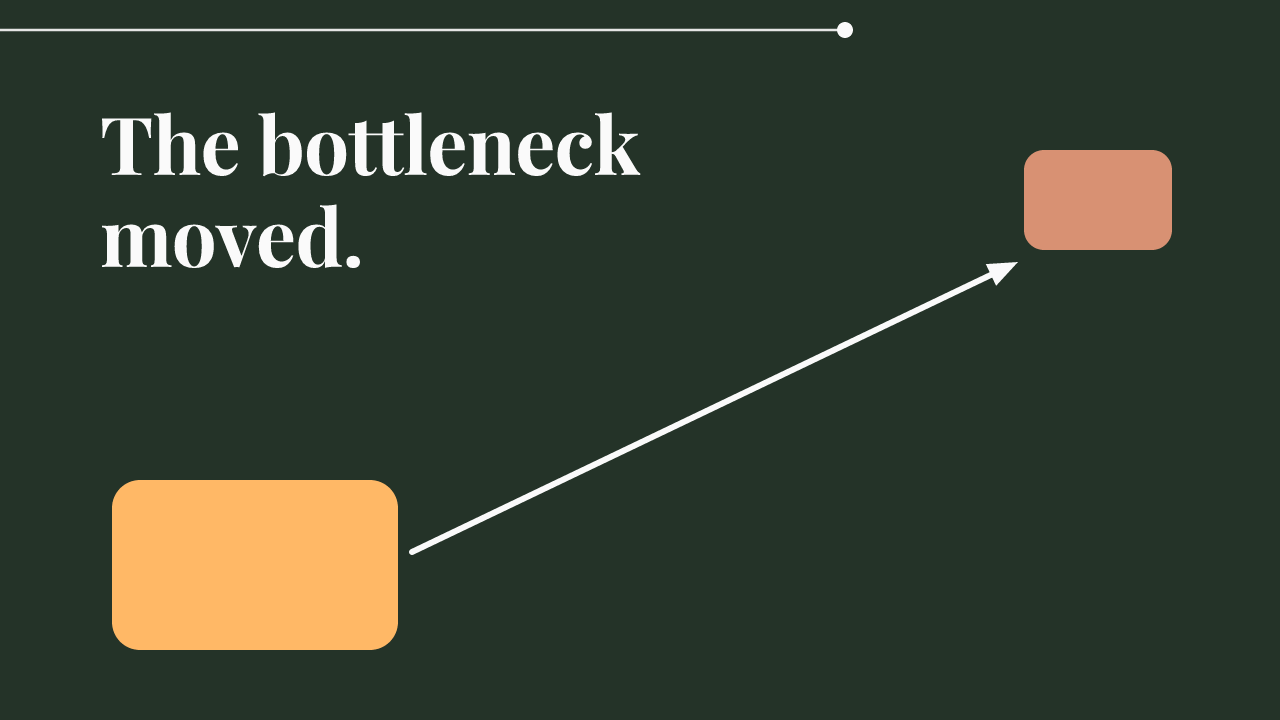
The bottleneck moved
For years the shape of my working day was fixed. More ideas than time, and the doing was the slow part: writing the code, running the analysis, drafting the post. A new thought could wait in my head for a day, because the queue ahead of it barely moved and my head could hold it without strain.
Agents removed most of that. Work that used to fill an afternoon comes back in minutes, and it never comes back finished in the old sense. It comes back as new information plus a decision. Is this right. Does it ship. What follows from it. Each decision is small, but they arrive from every stream at once, and the deciding piles up in a way the doing never did.
I want to be concrete about what that feels like, because “information overload” sounds abstract until it happens to you on a Tuesday. It is a thought arriving with nowhere to land, because three other thoughts are already circling and the thing on screen still needs your attention. My brain can barely keep up. Some days it does not.
None of this is a complaint about the tools. The work I wanted to do was always bigger than the time I had, and now more of it happens. But the part of me that has to keep up is the same brain as before, and it was never the part that typed.
I have written about giving a coding agent a memory between sessions, which makes handovers cheaper and the pace faster still. Every improvement on the doing side sharpens the same problem on the deciding side. The bottleneck does not disappear when you remove it. It moves.
Paper caught the overflow
The notepad is a buffer, in the plain engineering sense: a place where things wait so that nothing upstream has to hold them. The moment a thought occurs, a thing to check, a decision I cannot take yet, an idea worth following up, it goes on the page and my head is allowed to drop it. That last part is the whole value. Writing it down does not organise anything. It frees the slot.
This is also why the notebook lives in the purse. Thoughts do not wait for the desk, and a buffer you cannot reach is not a buffer.
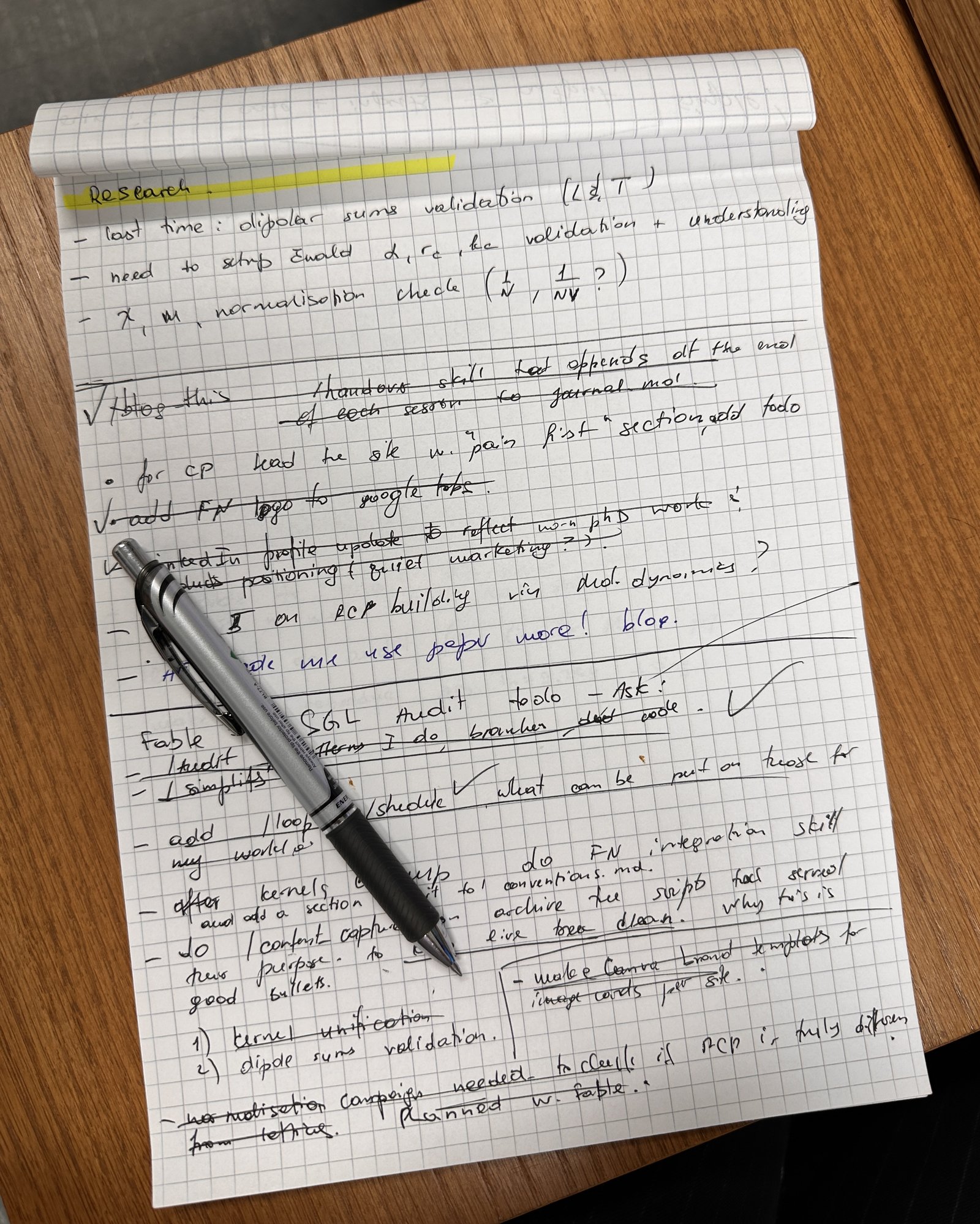
The notes themselves would disappoint anyone hoping for a diary. Short items, checks, half-sentences that only need to survive a few hours, each crossed out as it is dealt with. The pad is a queue, not a journal, and a full page of struck-through lines is what progress looks like on it.
Why the phone lost
The phone should win this contest. It is always with me, it syncs, it searches. And yet I resist capturing on it, and the resistance came before I could explain it. Paper feels more real: physical, just there.
Part of it is the cost at the moment of capture. Unlock, find the app, land on a screen with its own demands. By the time the note is typed I have visited another place, and the thought I was protecting had to survive the trip.
The bigger part is what happens at retrieval. Looking at one screen to fetch what I noted, only to pass it onto another screen, simply does not work for me. The note joins the same visual field as everything else demanding attention, and it dissolves into it. Paper sits beside the screens rather than competing with them. I glance down, cross something off, glance back. The channel the work runs on is never interrupted.
The lowest-tech tool in the room
So the oldest tool on my desk has survived the most technology-dense year of my working life, and I do not think that is nostalgia. The notepad occupies a niche nothing digital fits: it holds half-formed things and asks nothing back. No unlock, no app, no sync state, no second screen. It cannot interrupt, so it never competes.
The stack of used notepads on my shelf turns out to be an honest metric. It only grows when everything else speeds up.
— KEEP READING
More posts
-
Make your AI agent state its assumptions
AI agents invent plausible premises and write confident code on top of them. Here is the config rule that forces the assumptions into the file first.
-
Make your AI agent's rules executable, not just documented
A documented rule your AI coding agent keeps overlooking is a rule you should make executable. Here is why a lint-style hook on every edit fixes it for good.